The Weather Conditions That Actually Predict a Good Birdwatching Day
Quick Answer: The best birdwatching days combine calm wind, a recent weather shift (right after a front passes), and early morning timing — not simply ‘nice weather,’ which is often actually mediocre for bird activity compared to the hour right after a storm clears.
You’ve had gorgeous, sunny, calm days with barely a bird in sight, and then a scrappy, cloudy morning right after a cold front where you couldn’t keep up with sightings. That’s not luck — weather patterns genuinely predict bird activity, once you know what to look for.

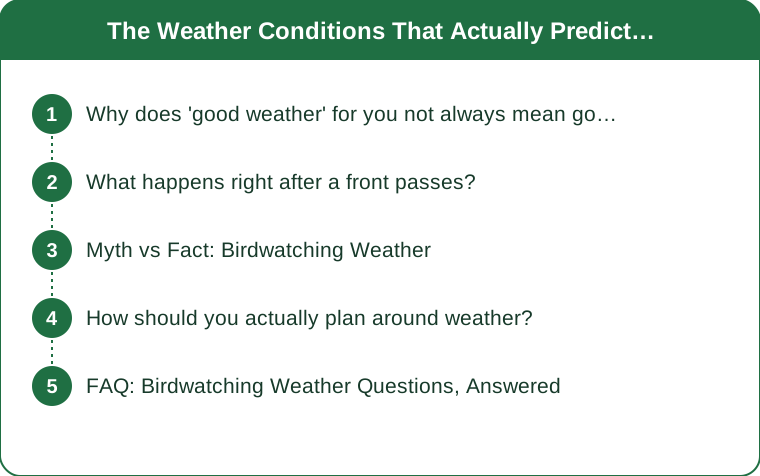
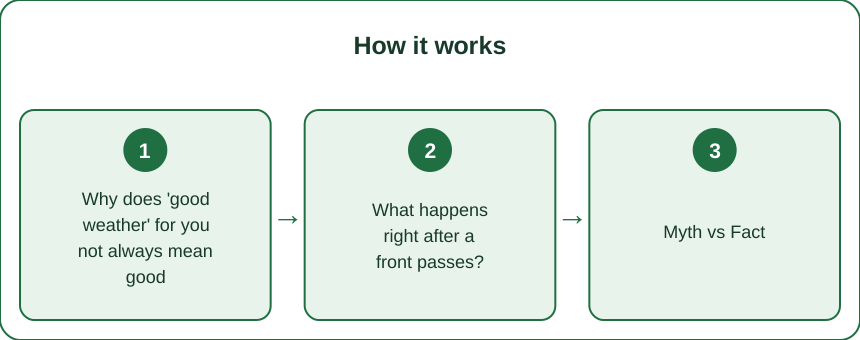
Why does ‘good weather’ for you not always mean good birdwatching?
Because birds respond to pressure changes and wind, not to whether a day looks pleasant to a person. A stable, sunny, breezy afternoon can be quiet simply because birds have already fed and settled by mid-morning, and steady wind makes both flight and foraging less appealing to them.
The conditions that draw birds out and moving are often the less obviously ‘nice’ ones — right before or right after a change in the weather.
What happens right after a front passes?
Migratory birds in particular tend to move with weather systems, often grounding in large numbers the morning after a cold front passes through, especially if it brought a tailwind in their direction of travel overnight. Birders call these ‘fallout’ mornings, and they can be dramatically more active than an average day.
Checking a basic weather forecast for a front passing overnight, then heading out early the next morning, is one of the most reliable ways to time a notably good session.

Myth vs Fact: Birdwatching Weather
Myth: Sunny, calm days are always best. Fact: Calm helps you hear and spot birds more easily, but sunny mid-day conditions often coincide with lower bird activity than early morning or post-front conditions.
Myth: Rain ruins birdwatching. Fact: Light, steady rain can be fine — birds often feed actively in a lull between rain bands. Heavy, driving rain is what actually shuts activity down.
Myth: Wind doesn’t matter much. Fact: Strong sustained wind (15mph+) noticeably suppresses both bird activity and your ability to hear calls, making it one of the more reliable factors to check before heading out.
How should you actually plan around weather?
Check for wind speed under 10mph and any recent front passage in the last 12-24 hours before deciding when to go — those two factors alone predict activity better than temperature or sunshine.
Early morning (the first 2-3 hours after sunrise) still outperforms weather timing on an average day, so when a front-passage morning and early timing line up, that’s the highest-probability combination available.
FAQ: Birdwatching Weather Questions, Answered
Is it worth birdwatching on a cloudy day?
Often yes — overcast conditions don’t suppress activity the way strong wind or heavy rain does, and some birders find cloudy light actually easier on the eyes through binoculars.
How do I know if a front recently passed?
A basic weather app showing a temperature drop, wind shift, or recent rain within the past day is a reasonable signal — no specialized tools needed to get the general idea.
Does extreme heat reduce bird activity?
Yes, similar to humans, birds tend to reduce activity during the hottest midday hours in summer, concentrating more near water sources instead.
TL;DR:
- Calm wind (under 10mph) and recent front passage predict activity better than ‘nice’ weather
- Fallout mornings after a cold front can be dramatically more active than average
- Heavy rain suppresses activity; light rain often doesn’t
- Early morning plus a recent front is the strongest combination to plan around
Check wind and recent weather shifts before you head out — they matter more than whether the sky looks pretty.
Keep Reading
This article is for general informational and styling purposes only. Fit, sizing, and product availability may vary.