Why the Birds in Your Yard Suddenly Look Wrong
Quick Answer: Late summer and early autumn is when most songbirds molt into nonbreeding plumage and when this year’s young birds are on the move, so a large share of what you are seeing is dull, streaky, and genuinely hard to identify. Even experienced birders slow down in this window. Shift your identification strategy from colour to shape, behaviour, and call, and treat unidentified birds as normal rather than as failure.
In May you could name everything in the yard from across the garden. It is late August and you are looking at a small yellow-green bird with no obvious markings, and you have no idea.
You have not lost the skill. The birds changed.

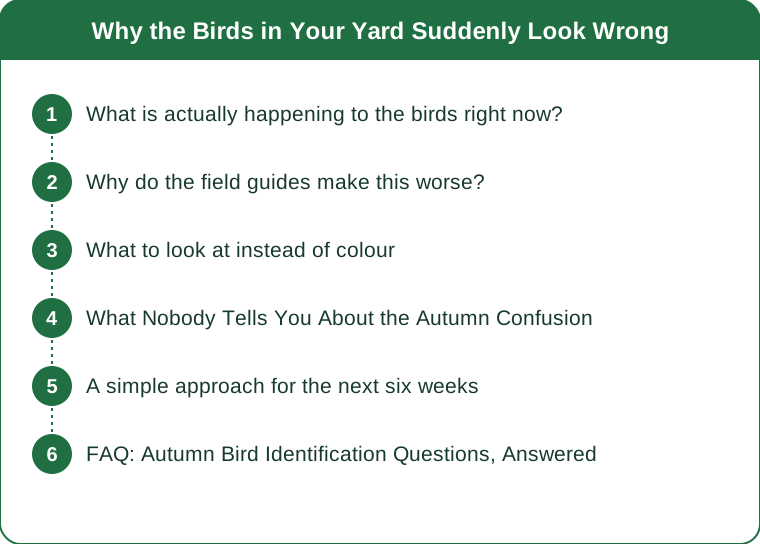
What is actually happening to the birds right now?
Three things at once, and they all reduce how identifiable a bird is.
Molt. Most songbirds replace their feathers after breeding, and many species move from a bright breeding plumage into a much duller nonbreeding one. A male warbler that was black, white, and orange in May can be a washed-out olive bird by September. Mid-molt birds can also look genuinely scruffy - patchy, ragged, sometimes missing tail feathers entirely.
Young birds. This year’s fledglings are now flying around in juvenile plumage, which for most species is duller and more streaked than either adult. There are simply far more birds in the population right now than in spring, and a large share of them are wearing plumage you have never studied.
Silence. Song is territorial and breeding-related, so most species stop singing once breeding ends. The bird you identified by voice all spring is now giving a single short call note, or nothing at all.
Combine those and the yard genuinely is harder than it was in May.
Why do the field guides make this worse?
Because most guides lead with the bright, distinctive breeding male - the version that is easiest to draw, easiest to describe, and least like what is in front of you right now.
This produces a specific frustration: you flip through the guide, nothing matches, and you conclude you are missing something obvious. In fact the bird may be on the page, in a small secondary illustration labelled autumn or immature, which is easy to skip past.
The practical fix is to deliberately study the nonbreeding and juvenile illustrations for the ten or so species you see most often, before you need them. Ten minutes with the guide on a rainy evening pays for itself repeatedly through September.
There is a well-known term for the hardest group here, and it exists precisely because this is a recognised problem rather than a personal failing. Generations of birders have found this season difficult, and many of them wrote it down.
What to look at instead of colour
Colour is the least reliable feature in the next six weeks. These are more stable:
Shape and proportion. Bill length and thickness, tail length relative to body, overall bulk. A bird’s structure does not molt. This is the single biggest upgrade in identification skill, and autumn is when it pays off.
Behaviour. How does it move? Does it creep along a branch, flick its tail constantly, hover at leaf tips, or forage on the ground? Many species have highly characteristic movement patterns that are unchanged by plumage.
Habitat and position. Ground, low shrub layer, mid canopy, or treetop - most species are consistent about where they feed.
Call notes. They stop singing but they do not go silent. Short chip and seep notes carry species information, and they are how experienced birders identify much of what passes overhead.
Wing bars and face pattern. These are often the last markings to remain visible in dull plumage, and they narrow things down more than overall colour does.

What Nobody Tells You About the Autumn Confusion
Experienced birders leave birds unidentified constantly. The difference is that they are comfortable writing down unidentified small warbler and moving on. Treating every bird as a puzzle you must solve turns a pleasant hour into a test.
This is the best season for numbers, not for names. Migration means more individuals and more species passing through a given yard than at any other time of year. If you count instead of naming, autumn is spectacular.
Photographs are far more useful now than in spring. A dull bird in poor light is nearly impossible in the moment and often solvable at home on a screen, zoomed in, with a guide open. A phone through one binocular barrel works better than people expect.
The birds are quieter but not gone. People often assume the yard has emptied in August. Usually it is just as busy and much less noisy, so it takes deliberate looking rather than passive listening.
Your spring skills are still there. Nothing you learned is lost. It is temporarily less applicable, and it comes straight back in April - with the bonus that a season of shape-and-behaviour practice makes spring identification faster than it was before.
A simple approach for the next six weeks
Rather than trying to name everything, use a sequence.
First, note structure. Size relative to a familiar species, bill shape, tail length. Write it down before the bird leaves.
Second, note behaviour and position. One sentence is enough - low in shrubs, flicking tail, working along a branch.
Third, note the two or three most obvious markings. Wing bars, eye ring, streaked or plain underparts, any tail pattern.
Fourth, photograph if possible. Even a poor photo captures details memory will not.
Then look it up later, not in the moment. Standing with a guide open while a bird moves through leaves is how people miss the bird entirely.
A notebook with those four fields, used for six weeks, will teach you more than any spring of easy identifications - because you are being forced to use the durable features instead of the convenient ones.
FAQ: Autumn Bird Identification Questions, Answered
Are there fewer birds in my yard right now?
Almost certainly not - there are usually more. They are quieter, less territorial, and often feeding in dense foliage rather than singing from exposed perches, which makes a busy yard feel empty.
When do the birds look normal again?
Most species are through molt by mid autumn, and the ones that overwinter with you settle into a stable plumage you can learn. Breeding plumage returns in spring, some of it through a second molt and some through the wearing away of feather edges.
Should I keep my feeders up during migration?
Yes. Feeders support both resident birds and migrants passing through, and autumn is a high-traffic period. Keep them clean - warm weather plus heavy use is exactly when feeder hygiene matters most.
Is a bird app good enough for this season?
Sound identification apps are genuinely useful for call notes, and photo apps help narrow options. Both are less reliable on dull autumn plumage than on spring males, so treat a suggestion as a starting point rather than an answer.
TL;DR:
- Late summer birds are molting into nonbreeding plumage and the population is full of dull juveniles.
- They have also stopped singing, removing the identification shortcut you relied on all spring.
- Field guides lead with bright breeding males, which is the version least like what you are seeing.
- Switch to shape, behaviour, habitat, and call notes - none of those molt.
- Photograph and identify later. Autumn birds are far easier on a screen than through leaves.
- Leaving birds unidentified is normal, including for people who have done this for decades.
This is the season that makes birders rather than the season that discourages them. Six weeks of hard birds and your spring identifications will be twice as fast.
Keep Reading
This article is for general informational and styling purposes only. Fit, sizing, and product availability may vary.