The Binocular Habit That Doubles How Many Birds You Actually See
Quick Answer: The technique is to lock your eyes on the bird and bring the binoculars up to your eyes without looking away - never lower your head to the binoculars or search for the bird through them. Set the focus roughly for the distance before you lift, keep both eyes open as you raise, and use a nearby landmark as a reference for anything moving. With migration underway, this single habit is worth more than any equipment upgrade, because most birds now give you three seconds rather than thirty.
You saw it. You raised the binoculars. You saw leaves, more leaves, a completely different branch, and then nothing. The bird was there the whole time.
Why do birds disappear the moment you lift your binoculars?
Binoculars have a narrow field of view - typically somewhere in the range of six to eight degrees. That is a small circle of the world, and finding a specific point within it by sweeping is genuinely difficult.
Your eyes are the finding tool; the binoculars are the looking tool. The error almost everyone makes is treating the binoculars as a search device. They are not - they magnify a spot you have already located.
Any movement of your head breaks the line. Looking down at the binoculars as you raise them, even briefly, loses the fix your eyes had on the bird. When you look back up, the branch is one of forty identical branches.
Depth confuses the search further. Sweeping through foliage at the wrong focus distance makes everything a blur, so even when the bird is in the circle you may not register it.
And the birds are not waiting. Autumn migration means large numbers of birds moving through, frequently in mixed feeding flocks that pass through a tree in under a minute. The difference between a three-second acquisition and a ten-second one is the difference between a good morning and a frustrating one.
What is the correct way to raise binoculars?
Lock your eyes on the bird and do not look away. This is the whole technique. Everything else is support for it.
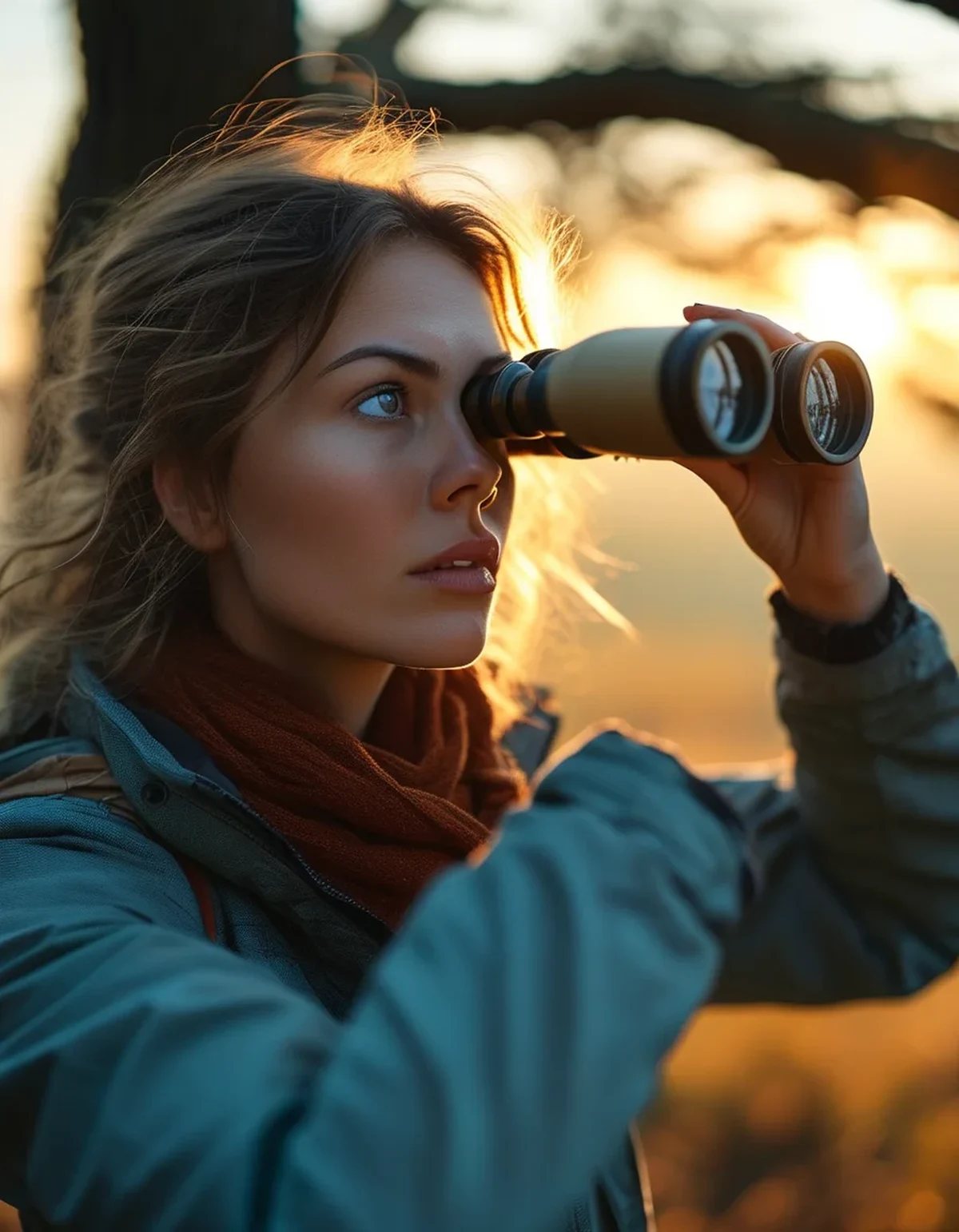
Bring the binoculars up to your eyes, not your eyes down to the binoculars. Your head stays exactly where it is, your gaze stays exactly where it is, and the binoculars travel up the line between your eyes and the bird.
Keep the barrels level and your elbows in. Raising with elbows out tends to introduce a tilt, which puts you slightly off the line. Tucked elbows also steady the image considerably.
Pre-focus roughly before you lift. If the bird is thirty metres away, having the focus already near thirty metres means you arrive with a recognizable image rather than a blur you then have to resolve while the bird moves.
Practise on stationary objects first. A specific leaf, a road sign, a chimney pot. Twenty repetitions in your garden builds the motor pattern faster than a whole morning in the field, and it costs nothing.
And adjust the fit once, properly. Set the barrel width so you see a single circle rather than two, and set the dioptre adjustment for the difference between your eyes. Most people never do this and spend years with a slightly wrong instrument. It takes five minutes and it is done.
What Nobody Tells You About Finding Birds
Nobody tells you to use a landmark rather than the bird. For a bird moving through foliage, fix on a distinctive nearby feature - a dead branch, a gap in the leaves, a lighter patch - and find that first. The bird is next to it, and the landmark holds still.
Nobody tells you that describing the location out loud helps. Saying halfway up, left of the split trunk, on the bare branch fixes it in your own memory as well as telling anyone with you. Birders use clock-face directions for exactly this reason.
Nobody tells you that both eyes stay open as you raise. Closing one eye while lifting removes your depth perception and your peripheral awareness at the precise moment you need both.
Nobody tells you to listen first, then look. A large share of experienced birders locate birds by ear and only then raise the binoculars to a known position - which turns a search into a confirmation. This is particularly relevant now, when nocturnal migrants are calling and mixed flocks announce themselves before they are visible.
And nobody tells you that neck strap length matters more than it sounds. Binoculars hanging too low mean a longer travel to your eyes and more opportunity to drift off the line. Shortened so they sit high on the chest, the raise becomes a small movement rather than a large one.
How do you build the habit quickly?
Do twenty raises a day on stationary targets for a week. Pick something small and specific each time, and check whether it is centred when you arrive. Being consistently off in one direction is diagnosable - usually a tilt or a habit of looking down.
Practise on moving targets that are easy. Gulls, pigeons, and crows are excellent training precisely because they are common, large, and unhurried. Nobody needs to know you were tracking a pigeon.
Use the first ten minutes of any outing as calibration. Rather than hunting for something interesting immediately, deliberately acquire five easy birds to warm up the motor pattern. It reliably makes the rest of the session better.
Get comfortable with the focus wheel by feel. Knowing roughly how far to turn it for close, mid, and far distances - without taking the binoculars from your eyes - saves the two seconds where most birds vanish.
Carry them ready rather than packed. A pair in a bag might as well be at home. The single strongest predictor of how many birds someone sees is how quickly they can get glass to their eyes.
And use this season. The next six weeks are among the busiest of the year for bird movement in most of the northern hemisphere, with mixed flocks moving through parks and gardens as well as reserves. High volume and short views is exactly the condition this technique was built for - which makes right now the fastest possible time to learn it.
FAQ: Binocular Technique, Answered
Why can I never find the bird in my binoculars?
Because you are searching with them rather than looking with them. Lock your eyes on the bird first and raise the binoculars along that line without moving your head or your gaze - the narrow field of view makes sweeping to find something extremely inefficient.
Should I keep both eyes open when using binoculars?
Yes, particularly while raising them. Closing one eye removes depth perception and peripheral awareness at the moment you most need them to stay on target.
How do I follow a bird that keeps moving?
Fix on a stationary landmark next to it - a bare branch, a gap, a distinctive shape - and acquire that instead. The bird moves; the landmark does not, and you can then work outward from it.
Do I need better binoculars to see more birds?
Usually not. Setting the barrel width and dioptre correctly, shortening the strap, and practising the raise improves most people’s results far more than an equipment upgrade would.
TL;DR:
- Your eyes find the bird; the binoculars only magnify it - never search through the lenses.
- Keep your gaze locked and bring the binoculars up the line, elbows tucked, both eyes open.
- Pre-focus roughly for the distance, and learn the focus wheel by feel so you arrive with a sharp image.
- Use a stationary landmark next to a moving bird, and say the location out loud to fix it.
- Set the barrel width and dioptre once, shorten the strap, and practise twenty raises a day on easy targets.
Migration is running right now and most views last seconds. The three you save on every bird is the whole difference.
Keep Reading
This article is for general informational and styling purposes only. Fit, sizing, and product availability may vary.