How to Catch a Migration Fallout - the Best Birding Day You Will Ever Have
Quick Answer: A fallout happens when night-migrating birds meet bad weather - headwinds, rain, or fog - and are forced down en masse at the first available habitat. Predict them by watching for a night of favourable migration winds followed by a front or rain arriving before dawn, then go at first light to the first patch of cover past a barrier: a coastal thicket, a headland, an island, or a woodland edge beside open water.
On an ordinary autumn morning you might see fifteen species. On a fallout morning, the same hedge can hold hundreds of birds.
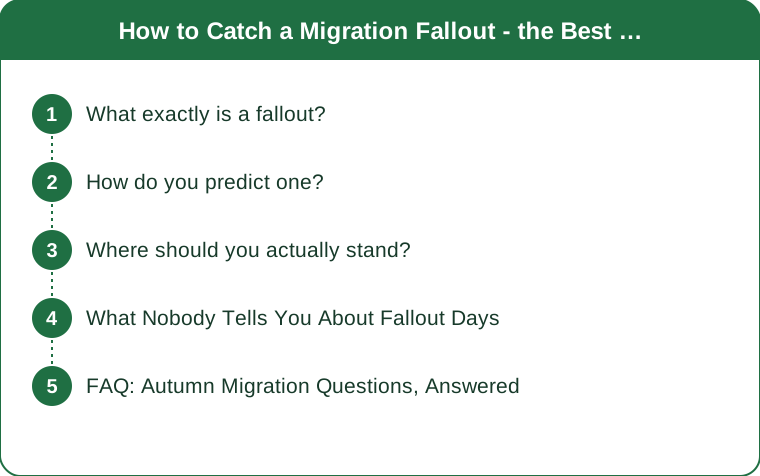
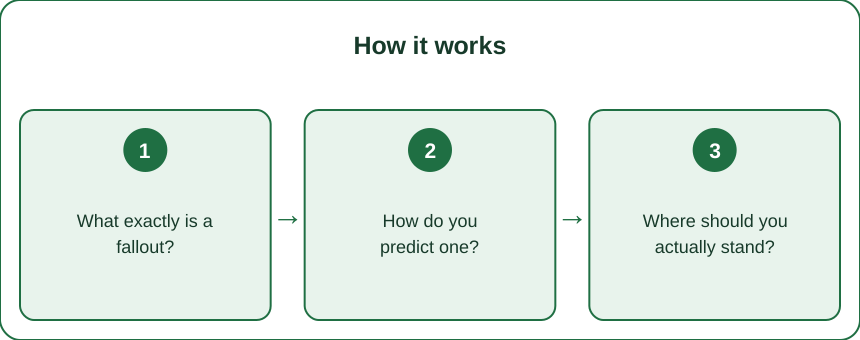
What exactly is a fallout?
A mass forced landing, and it is a weather event as much as a bird event.
Most songbirds migrate at night. They take off around dusk, climb to altitude, and fly for hours, navigating by stars, the earth’s magnetic field, and landmarks. On a good night, millions of birds are in the air over a single region.
A fallout occurs when that airborne population meets conditions it cannot continue through - a wall of rain, a strong headwind, thick fog, or a sudden temperature drop. The birds descend rapidly and land wherever they can. If that happens over water or open ground, they pile into the first cover they reach, which is why coastal thickets, headlands, and small islands produce the legendary numbers.
The result is birds behaving abnormally. Exhausted migrants feed in the open, at close range, low down, and largely ignore people. Species you would normally glimpse in a canopy are on the ground eating insects at your feet.
Fallouts are concentrated events, often over by mid-morning as birds recover and move on or disperse inland. The window is genuinely small - which is why prediction matters more than patience.
How do you predict one?
By reading the wind two nights ahead, then watching for something to stop it.
The setup you want has two parts:
Part 1 - a good migration night. Following winds in the direction of travel, clear skies, and settled conditions. This is what gets large numbers airborne in the first place. In the northern hemisphere autumn, that generally means northerly components pushing birds south.
Part 2 - something stopping them before dawn. A front arriving overnight, rain moving in, fog forming, or the wind swinging against them. The birds are already committed and in the air when the conditions change, which is exactly the situation that forces a landing.
Tools worth using:
- Weather radar. Migrating birds show up on radar as an expanding bloom after dusk. Several public tools now interpret this specifically for bird migration and produce nightly forecasts.
- Wind maps at altitude, not just surface wind.
- Local bird alert networks - a fallout is usually reported within an hour of dawn by someone.
The practical rule: if a good migration night is followed by rain or a front arriving between midnight and dawn, set an alarm.
Where should you actually stand?
At the first cover birds encounter after crossing an obstacle. Geography does most of the work.
The classic locations:
- Coastal headlands and points, especially those projecting into the direction of travel. Birds crossing water make landfall here first.
- Small islands and offshore reserves. Limited habitat concentrates enormous numbers into a small area.
- Coastal thickets, scrub, and any isolated stand of trees near open water or open ground. The more isolated the cover, the more concentrated the birds.
- Lakeshores and large river valleys, which act as barriers and as corridors.
- Urban parks and cemeteries. In a city, an isolated green space becomes a magnet - some of the best-known fallout sites are city parks surrounded by concrete.
Within a site, look at the sheltered side. After a night of wind and rain, birds gather where the wind is blocked and insects are active - the lee of a hedge, a sunlit sheltered edge, a sheltered corner of a wall.
Timing: be in position at first light. The best hour is often the first hour, and by mid-morning many birds have recovered and moved on. This is the one aspect of birding where being an hour late genuinely costs you the event.
What Nobody Tells You About Fallout Days
The birds are exhausted, and that changes what you owe them. These birds have flown all night and been forced down hungry. Every time you flush a feeding bird, you cost it energy it does not have. Move slowly, stay on paths, keep dogs on leads, and do not push into cover to get a better view. Watching from a distance produces better observations anyway, because undisturbed birds keep feeding.
Do not use playback on a fallout day. Calling in an exhausted migrant to no purpose burns energy it needs for refuelling. Most birding codes of conduct discourage it during migration for exactly this reason.
The identification is harder than usual, not easier. Autumn migrants are largely in non-breeding plumage, many are juveniles, and worn feathers make things ambiguous. Expect to leave with unidentified birds, and photograph rather than guess when you can.
Numbers can be genuinely overwhelming. New birders sometimes find a big fallout frustrating rather than thrilling because there is too much happening to process. Pick one patch of hedge and work it thoroughly instead of trying to see everything.
The event is short. Being there at 6:30am on the right morning beats being there all day on the wrong one. This is a hobby where checking the weather the night before does more than any equipment upgrade.
Not every predicted fallout arrives. The forecast conditions are necessary but not sufficient, and going out for a quiet morning is part of the deal.
FAQ: Autumn Migration Questions, Answered
When is fallout season?
In the northern hemisphere, the autumn window runs roughly from late August through October, varying by region and species group. Spring fallouts also occur and are often more dramatic because birds are in breeding plumage.
What time should I arrive?
First light, or before. The concentration is highest early and disperses through the morning.
Do I need expensive binoculars?
No. On a fallout day birds are close and in the open, which is precisely the situation where modest optics are fine. A notebook and knowing your local site matter more.
How do I find out if one happened?
Local birding groups, regional alert services, and community sightings platforms usually report within the hour. Following your regional group is the single most useful thing you can do.
Is it ethical to share the location of rare birds?
Depends on the species and the site. For common migrants, sharing is normal and helpful. For sensitive or vulnerable species, many regional groups have guidelines - follow them, and if unsure, ask before broadcasting a location.
TL;DR:
- A fallout is a weather event: a good migration night stopped by rain, fog, or a headwind before dawn
- Watch for a favourable migration night followed by a front arriving overnight
- Stand at the first cover past a barrier - a headland, an island, an isolated thicket, a city park
- Be there at first light; the event is often over by mid-morning
- These birds are exhausted - keep your distance, skip the playback, and let them feed
The next six weeks contain a handful of mornings that are better than the rest of the birding year combined. The difference between catching one and missing it is almost entirely whether you looked at the forecast the night before.
Keep Reading
This article is for general informational and styling purposes only. Fit, sizing, and product availability may vary.