Why the Best Birding of the Year Happens in the Next Six Weeks
Quick Answer: More birds move south in autumn than north in spring, because the population now includes every young bird raised this summer. Peak movement in most of the US runs from late August through early October, the birds move at night and land at dawn, and the best watching is the first two hours after sunrise on the morning after a night with a north wind. Bring binoculars, go to water or a woodland edge, and go early.
Spring migration gets all the attention because the birds are singing and brightly coloured. Autumn has more birds and fewer people, which is a better trade than it sounds.
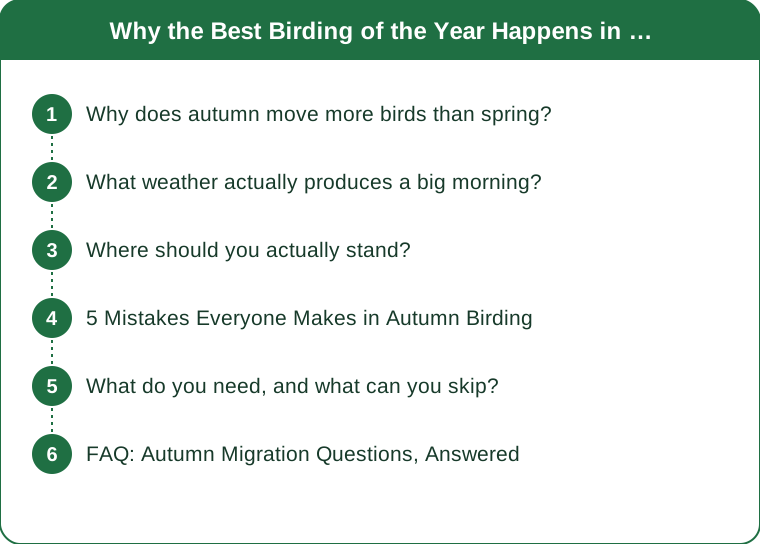
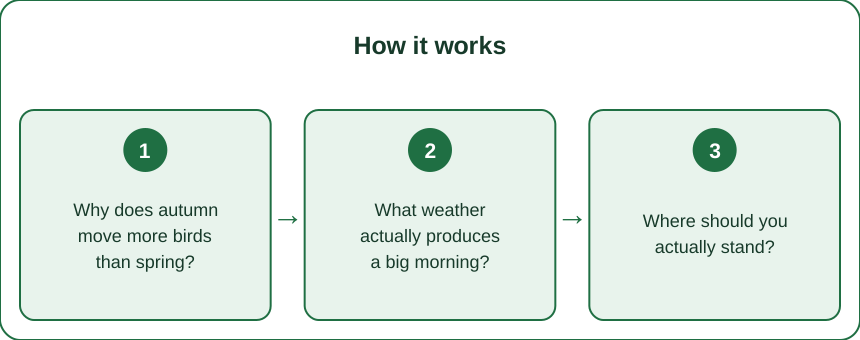
Why does autumn move more birds than spring?
Because the population is at its annual maximum.
In spring, the birds heading north are the survivors of the previous winter. In autumn, that same population is joined by every juvenile raised over the summer - which in many songbird species means the flock heading south is far larger than the one that came north.
Three things follow from that:
- Higher numbers, spread over a longer window. Spring migration is compressed because the birds are racing to claim breeding territory. Autumn is unhurried, so it spreads over two months rather than three weeks
- More young birds, which behave differently. Juveniles are less wary, more likely to feed at eye level, and much more likely to turn up somewhere unexpected. This is why autumn produces more surprising sightings
- Duller plumage, and that is the trade-off. Many warblers moult out of breeding colours, which is why autumn warblers have a reputation for being difficult to identify
The practical implication: if your goal is quantity and variety, autumn wins clearly. If your goal is easy identification, spring is kinder. Most people find the autumn challenge more interesting after their first season or two.
Timing across the US: shorebirds move earliest, often from July. Songbirds peak late August through September. Raptors peak mid-September through October. Waterfowl come last, into November.
What weather actually produces a big morning?
A cold front with a north wind overnight. This is the single most useful thing to learn.
Why it works: migrating songbirds move at night and prefer a tailwind. A north wind behind an autumn cold front is exactly that, so large numbers depart together. At dawn they come down to feed, and wherever they land is suddenly full of birds that were not there the day before.
What to look for in the forecast:
- A cold front passing through in the evening or overnight
- Winds shifting to the north or northwest
- Clearing skies behind the front
- A noticeable temperature drop
Then go out the next morning at first light. The concentration disperses through the day, so the first two hours after sunrise contain most of it.
The opposite condition: a warm southerly wind holds birds in place. Those mornings are quiet, and the birds that were held up will move on the next favourable night.
A useful modern tool: several public forecasting services now predict nightly migration intensity using weather radar, and they are surprisingly good. Checking one the evening before turns a hopeful outing into a targeted one.
The practical rhythm for the next six weeks: watch the forecast for a front, go the morning after, and accept that the mornings in between will be slower. Two well-chosen mornings beat six random ones.
Where should you actually stand?
Edges and water. Almost every productive autumn spot is one or the other.
Woodland edges where trees meet open ground. Migrants feed along these boundaries because there is more insect activity and better cover. Walking a hedgerow at 7am is more productive than walking through the middle of a wood.
Any water at all. A pond, a creek, even a large puddle in a park. Migrating birds need to drink and bathe, and water concentrates them reliably. A small park pond in a city can outproduce a large forest.
Coastlines and lakeshores. Birds moving south are reluctant to cross large water, so they pile up along the near shore. This is why coastal spots produce famous autumn concentrations.
Ridges, for raptors. Hawks use updrafts along ridgelines to travel efficiently. A ridge with a south-facing view on a September morning with a northwest wind can produce hundreds of birds in a few hours.
Your own neighbourhood, genuinely. Migrants come down wherever they are when the sun rises, which includes suburban gardens and city parks. Native trees and shrubs with berries or heavy insect life are magnets. A single native oak supports an enormous quantity of caterpillars, which is exactly what a migrating warbler is looking for.
The most underrated advice: pick one spot near home and visit it repeatedly across the season. Learning one place well produces more than visiting ten places once.
5 Mistakes Everyone Makes in Autumn Birding
1. Going too late. The concentration disperses quickly. A 9am start on a big morning misses most of what happened at 6:30. If you only have one hour, make it the first one.
2. Trying to identify everything. Autumn warblers are genuinely hard, and treating every bird as a test you have to pass makes the whole thing stressful. Watch behaviour, note the ones you can name, and let the rest go. The identification skill builds on its own across seasons.
3. Moving too much. New birders walk. Experienced birders stand still. Finding one active patch and staying with it for twenty minutes reveals far more than covering two miles, because the birds are moving through and you only need to be where they pass.
4. Buying the wrong binoculars first. The most common error is buying high magnification. 8x42 is the standard recommendation for good reason - higher magnification narrows the field of view and amplifies hand shake, which makes finding a moving bird in leaves much harder. Spend the budget on optical quality at 8x rather than on more magnification.
5. Ignoring sound entirely. Autumn birds sing much less, but they call constantly - short contact notes as they move through. Learning even five common call notes roughly doubles what you detect, and most people never start because they assume it is only for experts.
What do you need, and what can you skip?
Less than the hobby’s reputation suggests.
Genuinely necessary:
- Binoculars, 8x42. A reasonable pair sits somewhere in the low hundreds and will last decades. Below about that, the image quality makes identification harder rather than easier, which is discouraging early on
- A free identification app. Modern ones identify by photo and by sound, and the sound identification in particular is a genuine step change for beginners
- Something warm. Dawn in late September is much colder than the forecast high suggests, and standing still is colder than walking
Useful but not urgent:
- A regional field guide, for browsing at home rather than in the field
- A notebook, which sounds quaint and is the fastest way to actually learn
Skip for now:
- A spotting scope. Only worth it for shorebirds and waterfowl at distance
- A camera with a long lens. It is a separate hobby that competes for attention with the watching
- Expensive clothing. Muted colours and quiet fabric is the entire requirement
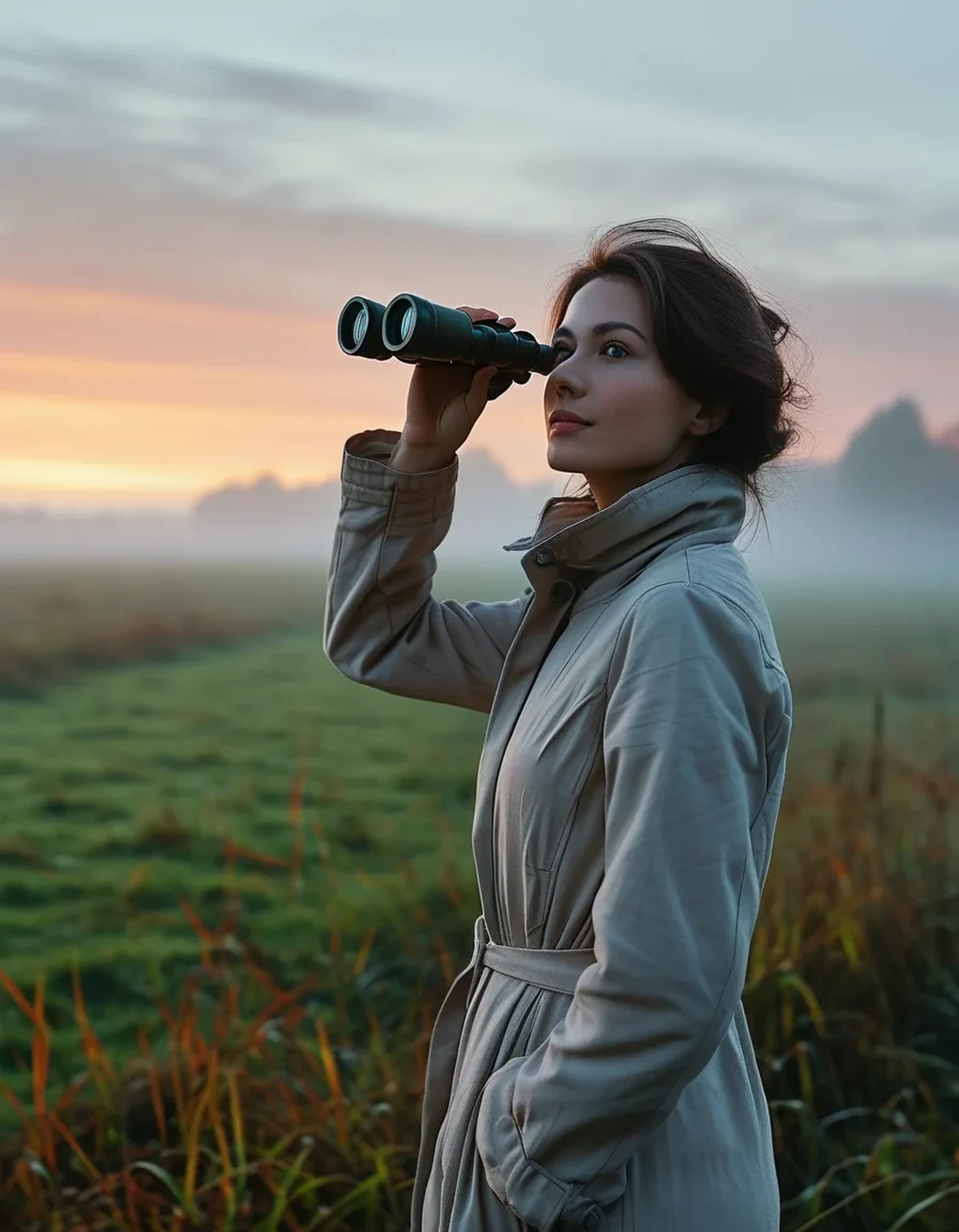
How to hold binoculars so you actually find the bird: keep your eyes on the bird and bring the binoculars up to your eyes without looking away. Everyone’s instinct is to look down at the binoculars first, and that is why beginners spend so long searching an empty patch of leaves.
One courtesy that matters: do not use recorded calls to draw birds in during migration. The birds are already using a lot of energy and repeatedly pulling them off feeding is genuinely costly to them.
FAQ: Autumn Migration Questions, Answered
When exactly is peak migration where I live?
It varies by latitude and by group, but for songbirds in most of the US, late August through the end of September is the core window. Raptors peak a few weeks later, waterfowl later still.
Do I need to get up before sunrise?
Being in place at sunrise is the goal. The birds land at first light and start dispersing within a couple of hours, so arriving at 6:30 rather than 9 changes the outing entirely.
Why are autumn birds so hard to identify?
Many species moult out of bright breeding plumage, and juveniles look different from adults. Focus on shape, size, and behaviour before colour - those stay constant.
Is birding worth it in a city?
Yes, and often better than expected. City parks act as isolated habitat islands, which concentrates migrants heavily. Some of the best-known autumn spots in the US are urban parks.
TL;DR:
- Autumn moves more birds than spring because every young bird from summer is included
- Go the morning after a cold front with a north wind - that is where the big days are
- Be in place at sunrise; most of it is over within two hours
- Stand still at a woodland edge or beside water rather than walking
- 8x42 binoculars, an ID app, and a warm layer is the entire kit
Six weeks, more birds than any other time of year, and almost nobody else out there. Check the forecast tonight and pick your morning.
Keep Reading
This article is for general informational and styling purposes only. Fit, sizing, and product availability may vary.